
Medical Air Evacuation in WWII – One Patient’s Journey
Flight nurse Lt. Georgie Taylor smiled at Private Hawkins, who was recovering from abdominal surgery due to a rifle wound. “We’ll be in Tunisia . . .”
He was too pale. Restless. His hand chilled her. Georgie leaned closer, her mind tingling with concern. “Are you all right?”
“Thirsty.” He rubbed his throat with white fingers.
She wrapped her hand around his wrist to measure his pulse—rapid as she feared. No doubt about it. He was going into shock, probably from postsurgical internal bleeding. (On Distant Shores, p. 55)
Before World War II, medical air evacuation was little but theory—by the end of the war, it was recognized as vital to patient care. I enjoyed following the development of air evacuation in my Wings of the Nightingale series, which featured three flight nurses based in the Mediterranean.
This blog series discusses:
Part 1: General Principles of Air Evacuation
Part 2: The Patient’s Flight Experience
Part 3: The Flight Nurse
Medical Air Evacuation in WWII – One Patient’s Flight Experience
From the Battlefield to the Airfield
Let’s follow my fictional patient, Private Hawkins. In the battle for Troina, Sicily, in early August 1943, Hawkins is shot in the abdomen. Medics perform first aid and take him from the battlefield to the battalion aid station, where he’s stabilized. An ambulance carries him to a field or evacuation hospital, where he undergoes abdominal surgery. After he’s stabilized, an ambulance takes him to the airfield at Termini Imerese, Sicily, and a C-47 will fly him to the large US hospital complex at Mateur, Tunisia, since he will need a long recuperation. (Read more: Hospitalization in World War II—Evacuation of the Wounded).
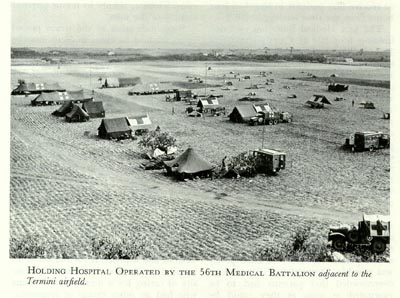
Holding hospital, 56th Medical Battalion, Termini Airfield, Termini Imerese, Sicily, 1943 (US Army Medical Department, Office of Medical History)
Pre-Flight
At Termini he arrives at a tent hospital at the airfield. The flight surgeon evaluates the patients to decide which are good candidates for air evacuation. Due to high altitude and unpressurized aircraft cabins, the doctors prefer not to send patients with serious head injuries, sucking chest wounds, or severe anemia. Each combat theater has different policies on “neuropsychiatric” patients, but if they’re allowed, an extra technician attends these patients.
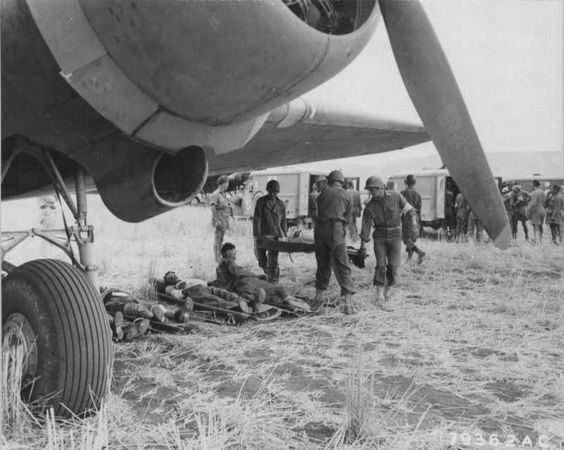
American and Italian wounded at Agrigento, Sicily, await evacuation by plane to Africa for further medical treatment, 25 July 1943 (USAAF photo)
At the airfield holding unit, the physician briefs flight nurse Lt. Georgie Taylor on each patient. Georgie in turn orients the patients—most of whom have never flown in an airplane—on what to expect during their flight. Private Hawkins wears an Emergency Medical Tag (EMT) which summarizes his condition and treatment. A large envelope with his medical records and X-rays rests beside him on the litter.
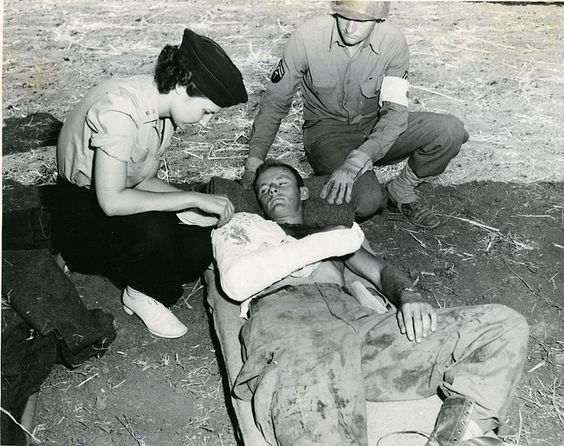
Flight nurse Verona Savinski, 802nd Medical Evacuation Transport Sqd., and Cpl. Claude W. Thomas 3rd Auxiliary Surgical Group, with Pfc. Joe Kirach of Brooklyn N.Y., 504th Parachute Infantry, Italy, 28 October 1943 (US National Archives)
Loading the Plane
The surgical technician and medics from the holding unit carry the litter patients onto the plane. At the cargo door, Georgie checks the EMT against the list of patients on her flight manifest and directs the tech where to place each patient based on his medical needs.
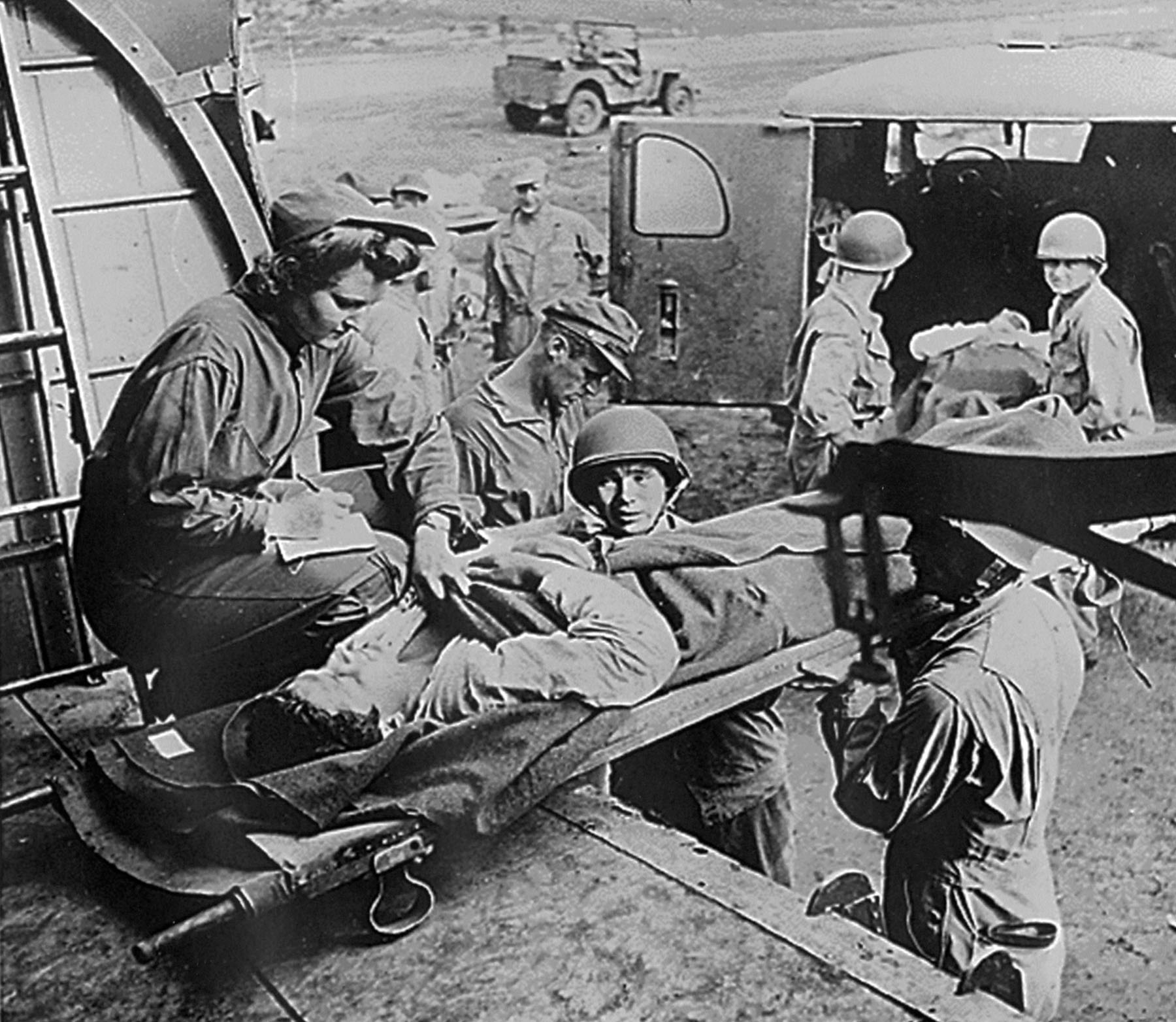
Flight nurse Lt. Mae Olson takes the name of a wounded American soldier being placed aboard a C-47 for air evacuation from Guadalcanal in 1943 (US Air Force photo)
The litters are clamped into aluminum racks along each side of the fuselage, stacked three litters high. Later versions of the C-47 will come equipped with lightweight web-strapping systems to hold litters. Hawkins is placed in the middle tier for easier access. Lower tiers are reserved for patients with heavy casts or needing more intense care.
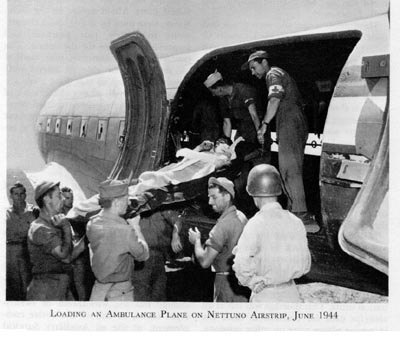
Patient being loaded into a C-47 for a medical air evacuation flight, Nettuno, Italy, June 1944 (US Army Medical Department, Office of Medical History)
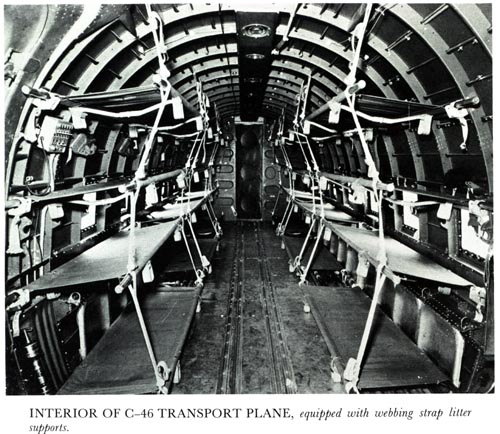
Interior of C-46 transport plane equipped with webbing strap litter supports (US Army Medical Department, Office of Medical History)
Flight
After the patients are secured, the C-47 glides down the runway. When the plane levels off, the flight nurse and technician see to the patients’ needs. They record Hawkins’s “TPR” (temperature, pulse, and respiration) on the flight manifest, and check for signs of bleeding and infection.
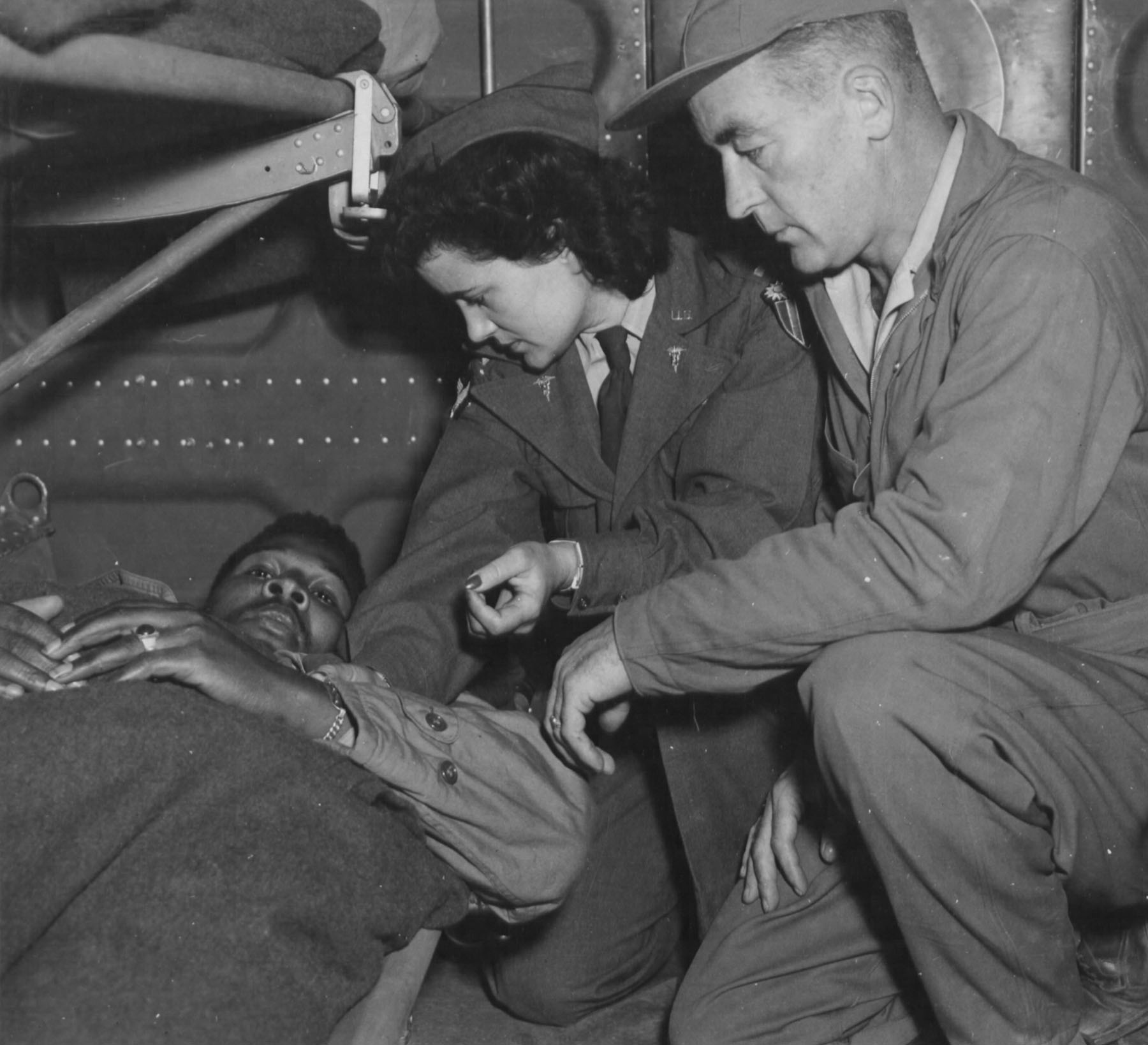
Air evacuation team from 803rd Medical Air Evacuation Transportation Squadron, Lt. Pauline Curry and Tech. Sgt. Lewis Marker, check a patient on a flight over India. (US Air Force photo)
The flight team provides water and food if needed. They converse with the patients, a voice of calm for the anxious and of encouragement for the depressed. If no patients are on oxygen, the men are allowed to smoke.
The interior of the C-47 is poorly ventilated and heated, and becomes stifling in hot weather and frigid in colder climates or higher altitudes. Smells can become overwhelming, especially when burn patients are aboard or when someone becomes airsick. Surprisingly, air sickness occurs in less than 1 percent of flights.
Georgie is trained to treat shock, hemorrhage, pain, air sickness, and other medical emergencies. When Private Hawkins goes into shock, Georgie and her technician administer plasma and oxygen to keep him alive.
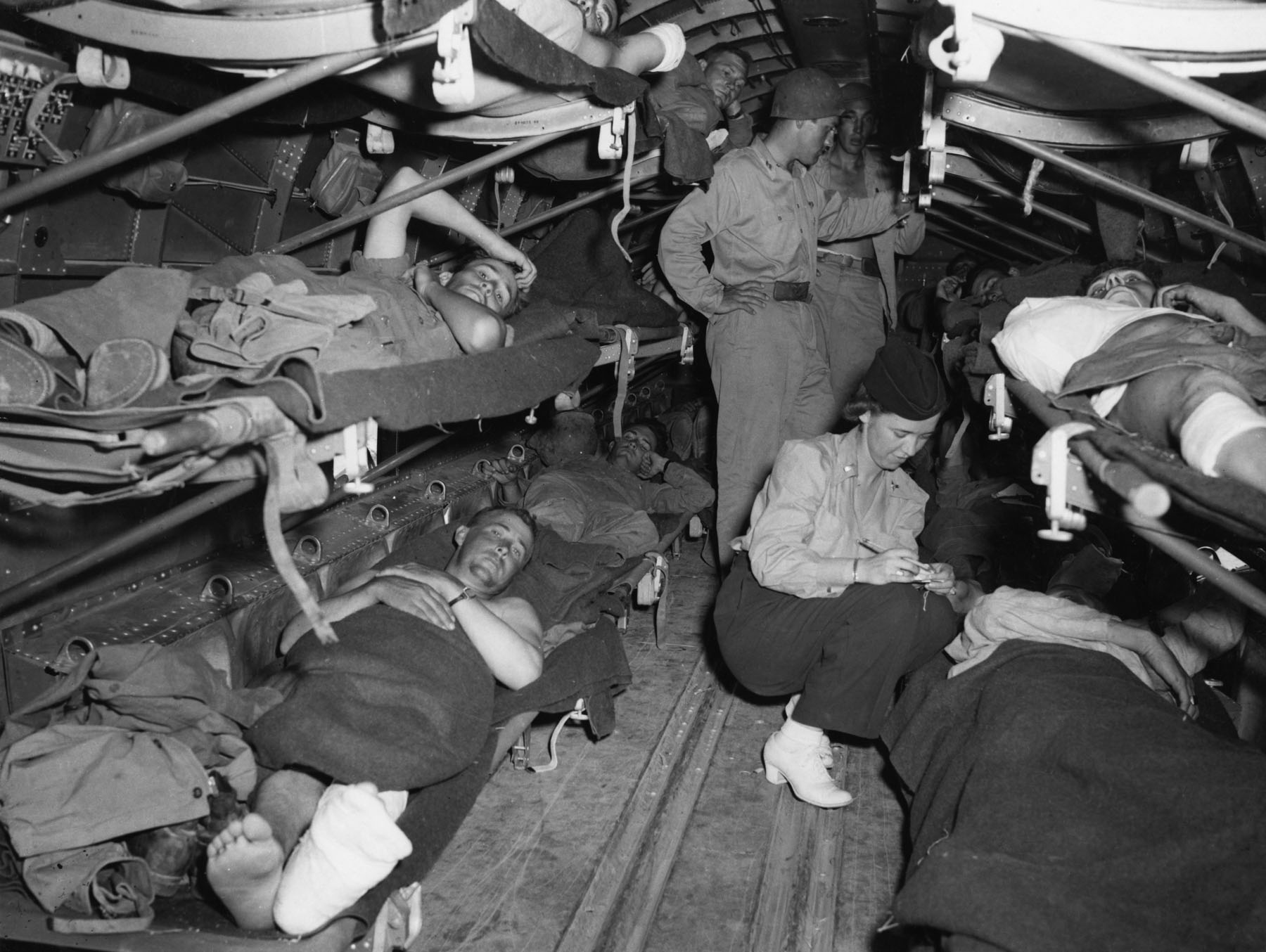
Lt. Katye Swope of the 802nd Medical Air Evacuation Transport Squadron checks patients being evacuated from Agrigento, Sicily to North Africa for further medical treatment, 25 July 1943 (US Air Force photo 25749AC)
Unloading
When the C-47 lands at Mateur, Georgie and the technician unload the plane with the help of men on the ground. A trained flight team can unload a full plane in 5-10 minutes, which is crucial in case of crash landing or ditching in water.
Due to Private Hawkins’s condition, he is rushed to the shock ward to be prepared for surgery. He will recover.
